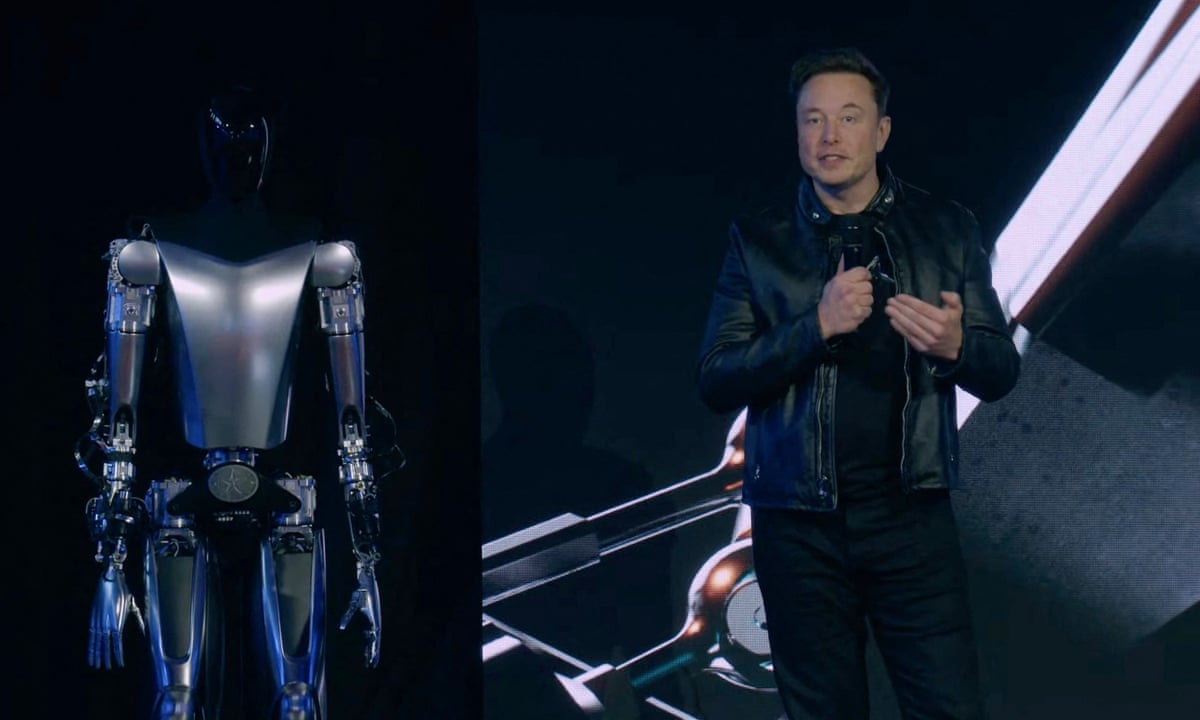
Tesla CEO Elon Musk has once again captured global attention, this time with an ambitious plan to deploy a fleet of humanoid robots designed to perform human-like tasks with remarkable efficiency. Speaking at a recent Tesla event, Musk emphasized that these robots are not just advanced machines—they represent a new era in productivity, automation, and global welfare. According to Musk, Tesla’s humanoid robots are five times more productive than the average human worker and could play a pivotal role in addressing labor shortages, enhancing manufacturing efficiency, and even alleviating poverty.
The Vision Behind Tesla’s Humanoid Robots
Musk has long expressed his belief that robotics and artificial intelligence (AI) will be central to the future of work. Tesla’s humanoid robots, sometimes referred to as “Tesla Bots,” are part of a broader vision to integrate AI and automation into everyday tasks, both in industrial settings and in society at large. The core idea is to design robots capable of performing tasks that humans do, from assembly line work and logistics to domestic chores, thereby freeing people to focus on creative, intellectual, or recreational pursuits.
Musk described the humanoid robots as highly versatile. “They will be able to lift objects, operate machinery, and even perform repetitive manual tasks with precision,” he said. He highlighted that these robots are being engineered to learn and adapt, meaning that their efficiency improves over time as they accumulate operational experience. This adaptability, combined with their human-like structure, makes them suitable for a wide range of applications.
Productivity That Surpasses Humans
One of the most striking claims made by Musk is that these humanoid robots are approximately five times more productive than a typical human worker. This is significant, especially in industries where labor shortages or repetitive tasks hinder growth. For example, in Tesla’s own factories, robots could handle complex assembly tasks at higher speed and accuracy, reducing errors and increasing overall output.
The productivity advantage stems from several factors. First, the robots are designed to work continuously without fatigue, unlike human employees who require breaks and rest. Second, their AI-driven control systems allow them to perform repetitive tasks with perfect consistency, eliminating human error. Finally, these robots can be deployed in hazardous environments, such as chemical plants or high-temperature production lines, where human safety could be at risk.
kalistahomes.com | bath-international.com | sangoxinh.com
kurdengineers.com | FreelanceIphone.com
Humanoid Design and Capabilities
Unlike traditional industrial robots, Tesla’s humanoid bots are designed to resemble humans in both form and movement. This anthropomorphic design allows them to navigate environments created for humans, such as factories, offices, and homes, without requiring specialized infrastructure modifications. The robots are equipped with advanced sensors, including vision systems, tactile feedback, and AI-powered decision-making software that helps them understand and interact with the world around them.
The humanoid robots are also designed with a focus on safety and efficiency. Musk emphasized that these robots are “friendly and obedient,” ensuring that they can work alongside humans without posing risks. Their programming includes constraints to prevent unintended harm, making them suitable for integration into both industrial and domestic settings.
Potential Applications Across Industries
The applications of Tesla’s humanoid robots are vast. In manufacturing, they can handle repetitive assembly, quality inspections, and material transport. In logistics, the robots could streamline warehouse operations, picking and packing items faster than human workers. Beyond industrial uses, Musk envisions applications in healthcare, agriculture, and home services. For instance, robots could assist elderly individuals, manage household chores, or perform agricultural labor such as planting, watering, and harvesting crops.
Musk’s vision extends to global economic implications. By deploying highly productive robots, countries and companies could significantly reduce operational costs, increase production output, and potentially lower prices for consumers. Additionally, by automating labor-intensive tasks, these robots could allow humans to pursue higher-level work, entrepreneurship, or creative endeavors.
Addressing Global Challenges
Elon Musk has framed the development of humanoid robots as not just a technological advancement, but a solution to broader societal challenges. He argues that as AI and robotics replace human labor, individuals will have more time for personal growth, leisure, and creative pursuits. Musk even suggested a scenario where humans could “grow vegetables” or engage in other meaningful activities while robots handle repetitive work.
The potential for these robots to address labor shortages is particularly relevant in industries facing a scarcity of workers. Aging populations in many countries, combined with the difficulty of attracting labor to certain jobs, make automation an attractive solution. By providing a reliable and efficient workforce, humanoid robots could help maintain production levels and support economic stability.
Ethical and Social Considerations
Despite the enthusiasm surrounding Tesla’s humanoid robots, there are significant ethical and social considerations. The prospect of widespread automation raises questions about employment, income distribution, and societal adaptation. Musk has acknowledged that while robots can increase productivity, societies will need to manage the transition carefully to prevent large-scale unemployment and ensure that economic benefits are widely shared.
Privacy and security are additional concerns. Humanoid robots with advanced sensors and AI systems will interact with sensitive environments and personal spaces, making robust safeguards essential. Tesla has indicated that safety and ethical programming are central to the robots’ design, but regulators and society at large will play a critical role in shaping the responsible deployment of this technology.
Future Roadmap and Deployment
Tesla plans to roll out its humanoid robots in phases, starting with controlled environments such as company factories before expanding to broader industrial and consumer applications. Musk has suggested that initial deployment will focus on demonstrating productivity gains and refining the AI systems through real-world experience. Over time, the goal is to create robots that are versatile enough to operate in multiple sectors, from logistics and manufacturing to domestic and agricultural work.
The robots are also expected to benefit from Tesla’s broader AI ecosystem, which includes neural networks, self-driving car technology, and machine learning algorithms. By leveraging these capabilities, the humanoid robots can learn from data collected in real time, continually improving their performance and efficiency.
Conclusion
Elon Musk’s humanoid robots are ambitious visions of the future of business, productivity and society. By developing machines that can perform human-like responsibilities with improved performance, Tesla aims to revolutionize industries and redefine the role of hard work in the 21 growth and financial growth.
As Tesla refines the humanoid robots, the field is closely watching how Musk’s imaginative and predictable projections unfold. If successful, they want to remake the way robotic humans draw, live and interact with generations, proposing a future where automation and AI transform society in unprecedented ways.
kalistahomes.com kalistahomes.com kalistahomes.com kalistahomes.com kalistahomes.com kalistahomes.com kalistahomes.com kalistahomes.com kalistahomes.com kalistahomes.com kalistahomes.com kalistahomes.com kalistahomes.com kalistahomes.com kalistahomes.com kalistahomes.com kalistahomes.com kalistahomes.com kalistahomes.com kalistahomes.com kalistahomes.com kalistahomes.com kalistahomes.com kalistahomes.com kalistahomes.com kalistahomes.com kalistahomes.com kalistahomes.com kalistahomes.com kalistahomes.com kalistahomes.com kalistahomes.com kalistahomes.com kalistahomes.com kalistahomes.com kalistahomes.com kalistahomes.com kalistahomes.com kalistahomes.com kalistahomes.com kalistahomes.com kalistahomes.com kalistahomes.com kalistahomes.com kalistahomes.com kalistahomes.com kalistahomes.com kalistahomes.com kalistahomes.com kalistahomes.com kalistahomes.com kalistahomes.com kalistahomes.com kalistahomes.com kalistahomes.com kalistahomes.com kalistahomes.com kalistahomes.com kalistahomes.com kalistahomes.com kalistahomes.com kalistahomes.com kalistahomes.com kalistahomes.com kalistahomes.com kalistahomes.com kalistahomes.com kalistahomes.com kalistahomes.com kalistahomes.com kalistahomes.com kalistahomes.com kalistahomes.com kalistahomes.com kalistahomes.com kalistahomes.com kalistahomes.com kalistahomes.com kalistahomes.com kalistahomes.com kalistahomes.com kalistahomes.com kalistahomes.com kalistahomes.com kalistahomes.com kalistahomes.com kalistahomes.com kalistahomes.com kalistahomes.com kalistahomes.com kalistahomes.com kalistahomes.com kalistahomes.com kalistahomes.com kalistahomes.com kalistahomes.com kalistahomes.com kalistahomes.com kalistahomes.com kalistahomes.com kalistahomes.com kalistahomes.com kalistahomes.com kalistahomes.com kalistahomes.com kalistahomes.com kalistahomes.com kalistahomes.com kalistahomes.com kalistahomes.com kalistahomes.com kalistahomes.com kalistahomes.com kalistahomes.com kalistahomes.com kalistahomes.com kalistahomes.com kalistahomes.com kalistahomes.com kalistahomes.com kalistahomes.com kalistahomes.com kalistahomes.com kalistahomes.com kalistahomes.com kalistahomes.com kalistahomes.com kalistahomes.com kalistahomes.com kalistahomes.com kalistahomes.com kalistahomes.com kalistahomes.com kalistahomes.com kalistahomes.com kalistahomes.com kalistahomes.com kalistahomes.com kalistahomes.com kalistahomes.com kalistahomes.com kalistahomes.com kalistahomes.com kalistahomes.com kalistahomes.com kalistahomes.com kalistahomes.com kalistahomes.com kalistahomes.com kalistahomes.com kalistahomes.com kalistahomes.com kalistahomes.com kalistahomes.com kalistahomes.com kalistahomes.com kalistahomes.com kalistahomes.com kalistahomes.com kalistahomes.com kalistahomes.com kalistahomes.com kalistahomes.com kalistahomes.com kalistahomes.com kalistahomes.com kalistahomes.com
infinityinspires.com codecraftes.com linklaunches.com pixelperkes.com quantumquestes.com sunshinstates.com techsthrive.com webeswhiz.com webswisdoms.com