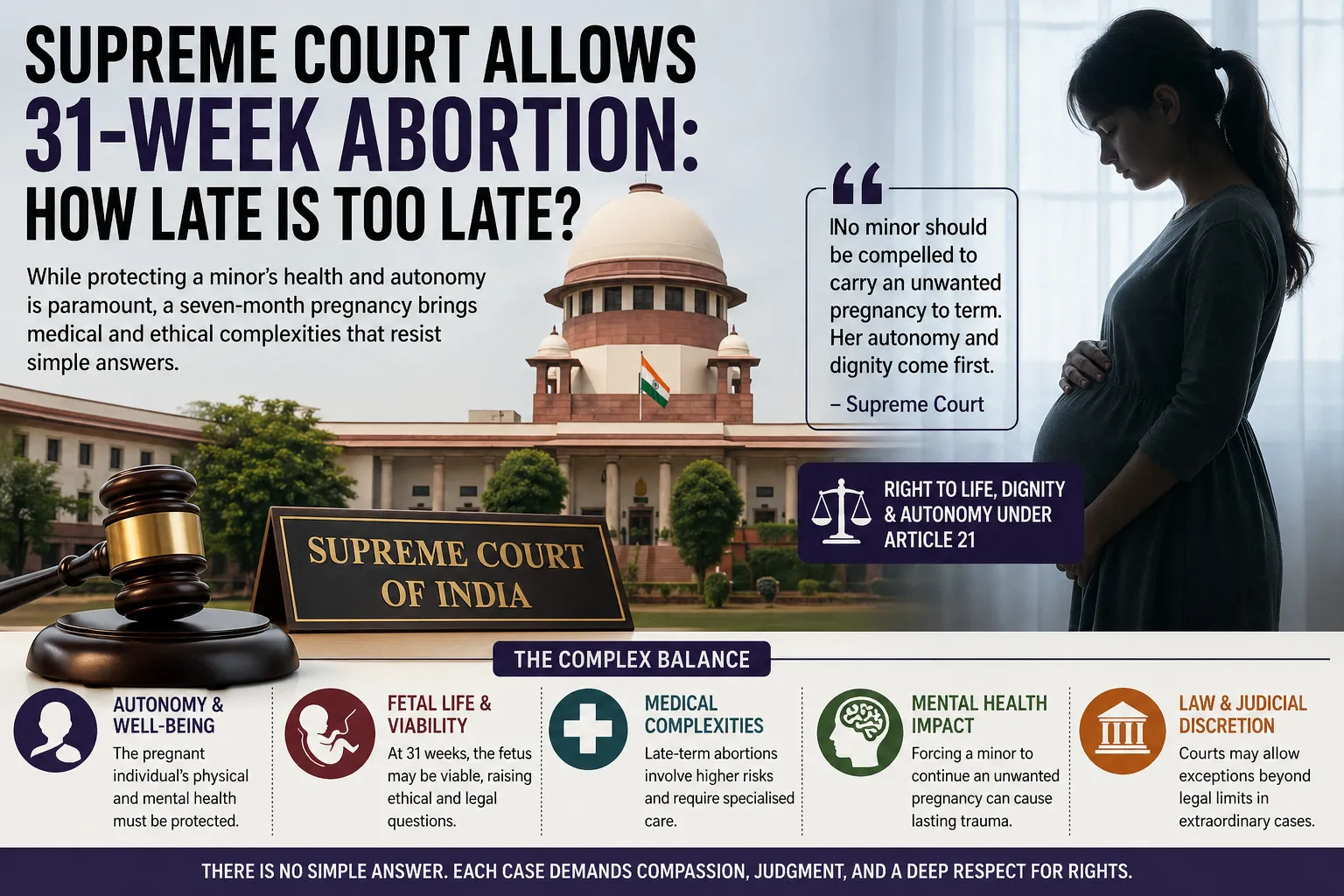
A recent decision by the Supreme Court of India to allow the medical termination of a 31-week pregnancy in the case of a minor has reignited a complex debate at the intersection of law, medicine, and ethics. The ruling, which prioritised the minor’s autonomy, dignity, and mental health, has raised an important and difficult question: how late is too late for an abortion?
The answer is far from simple. It lies in a delicate balance between legal frameworks, medical realities, and deeply personal ethical considerations.
The Case That Sparked the Debate
In April 2026, the Supreme Court permitted a 15-year-old girl to terminate her pregnancy at 31 weeks—well beyond the usual legal limit. The Court emphasised that forcing her to continue the pregnancy would violate her fundamental rights, including dignity, privacy, and personal liberty under Article 21 of the Constitution.
The judges highlighted her psychological distress and noted that reproductive autonomy must be given the highest importance, especially in the case of a minor.
This decision stands out because it goes beyond statutory limits, reflecting the Court’s willingness to interpret the law in light of individual circumstances.
What the Law Says About Abortion in India
Abortion in India is governed by the Medical Termination of Pregnancy (MTP) Act, originally enacted in 1971 and amended in 2021. The law generally permits abortion:
-
Up to 20 weeks under certain conditions
-
Up to 24 weeks for specific categories, including minors and survivors of sexual assault
-
Beyond 24 weeks only in cases of substantial fetal abnormalities or through court approval
The 31-week case clearly falls outside these standard limits. However, courts have increasingly allowed exceptions by interpreting the law alongside constitutional rights, especially when continuing the pregnancy could cause severe mental or physical harm.
Why Late-Term Abortions Are So Complex
Abortions in advanced stages of pregnancy—often referred to as late-term abortions—are among the most medically and ethically complicated procedures.
At 31 weeks, a fetus is considered viable in many cases, meaning it may survive outside the womb with medical support. This raises difficult questions:
-
Does the fetus have independent rights at this stage?
-
Should viability limit the right to terminate a pregnancy?
-
How should doctors weigh risks to the mother versus the fetus?
Medical professionals must also consider the increased risks associated with late-term procedures, including complications during delivery and the need for specialised care.
The Ethical Dilemma: Autonomy vs. Fetal Rights
The heart of the debate lies in balancing two competing considerations:
-
The pregnant individual’s autonomy and well-being
-
The potential life of the fetus
In the recent ruling, the Supreme Court clearly leaned toward prioritising the minor’s autonomy. It stated that no woman, especially a minor, should be compelled to carry an unwanted pregnancy to term.
This perspective aligns with a broader judicial trend that views reproductive choice as a fundamental right. However, it also raises ethical concerns, particularly in cases where the fetus is close to full development.
For many, the question is not just legal but moral—where should society draw the line?
Medical Realities: Risk, Viability, and Care
From a medical standpoint, late-term abortions are significantly more complex than early-term procedures.
Doctors must evaluate:
-
Maternal health risks: Physical and psychological impact on the pregnant individual
-
Fetal viability: Chances of survival outside the womb
-
Procedure safety: Availability of advanced medical facilities
In some cases, late-term termination may resemble a premature delivery, requiring neonatal care if the fetus is born alive. This adds another layer of complexity to both decision-making and execution.
Hospitals and medical boards often play a crucial role in such cases, providing expert opinions that guide judicial decisions.
Why Courts Intervene in Late Cases
When pregnancies exceed legal limits, individuals often approach courts for permission to terminate. The judiciary then evaluates each case individually, considering:
-
Medical reports
-
Mental health impact
-
Circumstances of conception
-
Risks to the individual
Courts have increasingly recognised that rigid timelines cannot account for every situation. In cases involving minors, sexual assault survivors, or severe distress, exceptions are more likely to be granted.
This case-by-case approach allows flexibility but also leads to inconsistency, as outcomes can vary depending on circumstances and judicial interpretation.
The Role of Mental Health
One of the most significant aspects of the recent ruling is the emphasis on mental health.
The Court acknowledged that forcing a minor to carry an unwanted pregnancy could have long-lasting psychological consequences.
This reflects a broader shift in legal thinking, where mental well-being is given equal importance to physical health. It also highlights the need for a more holistic understanding of reproductive rights.
Global Perspective: No Universal Answer
Globally, abortion laws vary widely:
-
Some countries allow abortion on request up to a certain gestational limit
-
Others permit late-term abortions only under strict conditions
-
A few impose near-total bans
There is no universal consensus on when abortion should no longer be allowed. Cultural, religious, and political factors all influence these laws.
India’s approach—combining statutory limits with judicial flexibility—attempts to balance competing interests, but it also reflects the ongoing struggle to define clear boundaries.
How Late Is Too Late?
The central question remains: how late is too late?
Legally, the answer depends on the framework of the MTP Act and judicial interpretation. Medically, it depends on viability and risk. Ethically, it depends on individual beliefs and societal values.
The recent Supreme Court ruling suggests that there is no fixed answer. Instead, each case must be evaluated on its own merits, with priority given to the rights and well-being of the individual.
The Way Forward
The growing number of late-term abortion cases highlights the need for:
-
Clearer guidelines: To reduce uncertainty and reliance on court intervention
-
Better access to early care: To prevent delays in decision-making
-
Stronger support systems: Including counseling and medical assistance
-
Public awareness: To ensure individuals understand their rights and options
At the same time, policymakers must continue to engage with ethical concerns and evolving medical knowledge.
Conclusion
The Supreme Court’s decision to allow a 31-week abortion is a landmark moment in India’s legal and social discourse. It underscores the importance of reproductive autonomy while also exposing the complexities of late-term pregnancy decisions.
Ultimately, the question of “how late is too late” does not have a simple answer. It is shaped by law, medicine, ethics, and individual circumstances. What the ruling makes clear, however, is that the dignity and well-being of the individual must remain at the center of any decision.
In a world where science and society are constantly evolving, the conversation around abortion will continue—and so will the challenge of finding a balance between rights, responsibilities, and compassion.
pulsitera.shop pulsitera.shop pulsitera.shop pulsitera.shop pulsitera.shop pulsitera.shop pulsitera.shop pulsitera.shop pulsitera.shop pulsitera.shop pulsitera.shop pulsitera.shop pulsitera.shop pulsitera.shop pulsitera.shop pulsitera.shop pulsitera.shop pulsitera.shop pulsitera.shop pulsitera.shop pulsitera.shop pulsitera.shop pulsitera.shop pulsitera.shop pulsitera.shop pulsitera.shop pulsitera.shop pulsitera.shop pulsitera.shop pulsitera.shop pulsitera.shop pulsitera.shop pulsitera.shop pulsitera.shop pulsitera.shop pulsitera.shop pulsitera.shop pulsitera.shop pulsitera.shop pulsitera.shop pulsitera.shop pulsitera.shop pulsitera.shop pulsitera.shop pulsitera.shop pulsitera.shop pulsitera.shop pulsitera.shop pulsitera.shop pulsitera.shop pulsitera.shop pulsitera.shop pulsitera.shop pulsitera.shop pulsitera.shop pulsitera.shop pulsitera.shop pulsitera.shop pulsitera.shop pulsitera.shop pulsitera.shop pulsitera.shop pulsitera.shop pulsitera.shop pulsitera.shop pulsitera.shop pulsitera.shop pulsitera.shop pulsitera.shop pulsitera.shop pulsitera.shop pulsitera.shop pulsitera.shop pulsitera.shop pulsitera.shop pulsitera.shop pulsitera.shop pulsitera.shop pulsitera.shop pulsitera.shop pulsitera.shop pulsitera.shop pulsitera.shop pulsitera.shop pulsitera.shop pulsitera.shop pulsitera.shop pulsitera.shop pulsitera.shop pulsitera.shop pulsitera.shop pulsitera.shop pulsitera.shop pulsitera.shop pulsitera.shop pulsitera.shop pulsitera.shop pulsitera.shop pulsitera.shop pulsitera.shop pulsitera.shop pulsitera.shop pulsitera.shop pulsitera.shop pulsitera.shop pulsitera.shop pulsitera.shop pulsitera.shop pulsitera.shop pulsitera.shop pulsitera.shop pulsitera.shop pulsitera.shop pulsitera.shop pulsitera.shop pulsitera.shop pulsitera.shop pulsitera.shop pulsitera.shop pulsitera.shop pulsitera.shop pulsitera.shop pulsitera.shop pulsitera.shop pulsitera.shop pulsitera.shop pulsitera.shop pulsitera.shop pulsitera.shop pulsitera.shop pulsitera.shop pulsitera.shop pulsitera.shop pulsitera.shop pulsitera.shop pulsitera.shop pulsitera.shop pulsitera.shop pulsitera.shop pulsitera.shop pulsitera.shop pulsitera.shop pulsitera.shop pulsitera.shop pulsitera.shop pulsitera.shop pulsitera.shop pulsitera.shop pulsitera.shop pulsitera.shop pulsitera.shop pulsitera.shop pulsitera.shop pulsitera.shop pulsitera.shop pulsitera.shop pulsitera.shop pulsitera.shop pulsitera.shop pulsitera.shop pulsitera.shop pulsitera.shop pulsitera.shop pulsitera.shop pulsitera.shop pulsitera.shop pulsitera.shop
infinityinspires.com codecraftes.com linklaunches.com pixelperkes.com quantumquestes.com sunshinstates.com techsthrive.com webeswhiz.com webswisdoms.com