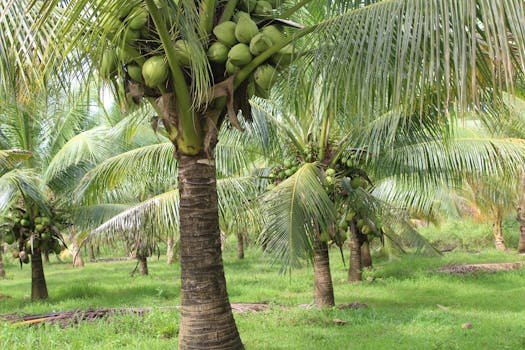
Coconut cultivation in India has long been associated with economic opportunity, particularly for smallholder farmers in peninsular regions and along the eastern and western coasts. Traditionally, government policies and schemes have focused on enhancing productivity, primarily through the distribution of high-yield seedlings. However, experts now argue that productivity alone is no longer the optimal goal. In the context of climate change, pest outbreaks, soil degradation, and water scarcity, sustainability has emerged as the key to ensuring the long-term viability and profitability of coconut farming.
Table of Contents
ToggleLimitations of Productivity-Centric Approaches
Historically, initiatives like the Coconut Development Board’s promotion programs have emphasized high-yielding varieties. While such varieties can increase short-term output, they often do so at the cost of resilience. Monoculture plantations of high-yield varieties are vulnerable to pests such as the rhinoceros beetle and red palm weevil, as well as diseases like root wilt and lethal yellowing. Over time, reliance on such varieties without attention to soil health, water management, and genetic diversity can compromise farm sustainability.
Moreover, high-yield varieties often require intensive input management — including fertilizers, irrigation, and pest control measures — which raises production costs and environmental footprint. Smallholder farmers, who constitute the majority of coconut cultivators in India, may struggle to maintain such input levels over the long term, leading to a cycle of debt and unsustainable practices.
Climate Change and Coconut Cultivation
Coconut palms are particularly sensitive to climatic conditions. Rising temperatures, unpredictable rainfall patterns, and salinity intrusion along coastal regions pose significant challenges to traditional coconut-growing zones. For instance, east coast farms are increasingly affected by cyclones, high wind speeds, and water stress, while west coast regions face the prevalence of root wilt disease exacerbated by changing rainfall patterns.
These climatic pressures highlight the urgent need to prioritize climate-resilient varieties in any promotion scheme. Varieties that can withstand salinity, drought, and other environmental stresses will not only ensure stable yields but also protect the livelihoods of farmers in vulnerable regions.
Wilt-Tolerant and Resilient Varieties
Root wilt disease remains one of the most devastating threats to coconut palms in Kerala, Karnataka, and other west coast states. Wilt-tolerant varieties have been developed through selective breeding and tissue culture methods, offering long-term protection against yield losses. Simultaneously, in peninsular India and along the east coast, climate-resilient varieties are crucial to combat water stress, erratic rainfall, and cyclone damage.
Focusing on these varieties requires a strategic shift from merely supplying high-yield seedlings to investing in mass multiplication programs. Tissue culture and seed garden development can help ensure that farmers have access to high-quality, disease-free planting material tailored to local environmental conditions.
The Role of the Coconut Promotion Scheme
The Coconut Promotion Scheme, as envisaged by government authorities, provides an important platform to influence the future trajectory of coconut farming. While distribution of seedlings is essential, the scheme’s success will depend on its ability to promote sustainability-oriented practices:
-
Development of Climate-Resilient Seedlings: The scheme must prioritize the creation and dissemination of varieties that can thrive under specific regional challenges, such as drought-tolerance for east coast farms and wilt-resistance for west coast farms.
-
Support for Farmer Education: Farmers must be trained in sustainable agricultural practices, including integrated pest management, organic fertilization, and water-efficient irrigation techniques. Knowledge transfer can significantly enhance the resilience of coconut farms while reducing dependency on chemical inputs.
-
Promotion of Genetic Diversity: Maintaining a diversity of coconut varieties helps mitigate risks from pests, diseases, and climatic shocks. Mixed plantings of traditional, high-yielding, and resilient varieties can stabilize yields and protect against total crop failure.
-
Infrastructure Development: Investment in nursery infrastructure, tissue culture laboratories, and disease-free seed gardens is critical. Such facilities can accelerate the production and supply of resilient varieties while ensuring quality control.
-
Monitoring and Research: Continuous monitoring of pest prevalence, climate impacts, and varietal performance allows for timely interventions. Linking the promotion scheme with research institutions and extension services ensures that farmers benefit from the latest innovations and best practices.
Economic and Environmental Benefits of Sustainability
Sustainable coconut cultivation offers multiple advantages. Economically, resilient varieties reduce the likelihood of total crop losses, protecting farmer incomes. Improved soil management, organic fertilization, and water-efficient practices reduce input costs over time and improve the longevity of plantations.
Environmentally, diversified and resilient farms contribute to better soil health, reduced chemical runoff, and enhanced biodiversity. Coconut palms themselves play a role in coastal protection, soil stabilization, and carbon sequestration, making sustainable cultivation a key component of climate adaptation strategies.
Global Lessons and Best Practices
Countries like Indonesia, the Philippines, and Sri Lanka have increasingly emphasized sustainability alongside productivity in coconut cultivation. They have invested in research centers for pest- and climate-resistant varieties and promoted cooperative models for seedling production. India can adapt similar strategies, tailored to local agro-ecological zones, to balance yield, farmer income, and ecological health.
Challenges in Implementation
Implementing sustainability-focused programs is not without challenges. Tissue culture propagation is resource-intensive, requiring significant investment in laboratory facilities and skilled personnel. Farmer adoption can also be slow if resilient varieties do not match immediate yield expectations. Additionally, coordinating distribution and extension services across smallholder farms, particularly in remote regions, presents logistical hurdles.
To overcome these challenges, public-private partnerships, farmer cooperatives, and regional research hubs can play crucial roles. Subsidies and incentives for adopting resilient varieties, along with extension services, can bridge the gap between research and field-level adoption.
A Paradigm Shift in Policy Thinking
The key message for policymakers is clear: coconut cultivation should no longer be viewed purely through the lens of high yield. The focus must shift to long-term resilience, climate adaptability, and sustainable farming practices. Productivity gains are important, but without resilience, gains may be short-lived and vulnerable to the next disease outbreak or extreme weather event.
By reorienting the Coconut Promotion Scheme to prioritize sustainability, India can secure the livelihoods of millions of smallholder farmers while ensuring that coconut cultivation remains economically viable and environmentally sound for generations to come.
Conclusion
Sustainability is no longer an optional consideration in coconut cultivation — it is essential. While high-yield varieties contribute to short-term productivity, they are insufficient in the face of climate change, pest pressures, and environmental degradation. By prioritizing climate-resilient and wilt-tolerant varieties, investing in mass multiplication programs, and equipping farmers with knowledge and infrastructure, India can safeguard its coconut sector for the future.
The success of the Coconut Promotion Scheme, and the wider health of India’s coconut industry, depends on this paradigm shift: from chasing maximum yield to ensuring sustainable, resilient, and profitable coconut cultivation. By embracing sustainability, the sector can thrive economically, socially, and ecologically in the decades to come.
modastor.com modastor.com modastor.com modastor.com modastor.com modastor.com modastor.com modastor.com modastor.com modastor.com modastor.com modastor.com modastor.com modastor.com modastor.com modastor.com modastor.com modastor.com modastor.com modastor.com modastor.com modastor.com modastor.com modastor.com modastor.com modastor.com modastor.com modastor.com modastor.com modastor.com modastor.com modastor.com modastor.com modastor.com modastor.com modastor.com modastor.com modastor.com modastor.com modastor.com modastor.com modastor.com modastor.com modastor.com modastor.com modastor.com modastor.com modastor.com modastor.com modastor.com modastor.com modastor.com modastor.com modastor.com modastor.com modastor.com modastor.com modastor.com modastor.com modastor.com modastor.com modastor.com modastor.com modastor.com modastor.com modastor.com modastor.com modastor.com modastor.com modastor.com modastor.com modastor.com modastor.com modastor.com modastor.com modastor.com modastor.com modastor.com modastor.com modastor.com modastor.com modastor.com modastor.com modastor.com modastor.com modastor.com modastor.com modastor.com modastor.com modastor.com modastor.com modastor.com modastor.com modastor.com modastor.com modastor.com modastor.com modastor.com modastor.com modastor.com modastor.com modastor.com modastor.com modastor.com modastor.com modastor.com modastor.com modastor.com modastor.com modastor.com modastor.com modastor.com modastor.com modastor.com modastor.com modastor.com modastor.com modastor.com modastor.com modastor.com modastor.com modastor.com modastor.com modastor.com modastor.com modastor.com modastor.com modastor.com modastor.com modastor.com modastor.com modastor.com modastor.com modastor.com modastor.com modastor.com modastor.com modastor.com modastor.com modastor.com modastor.com modastor.com modastor.com modastor.com modastor.com modastor.com modastor.com modastor.com modastor.com modastor.com modastor.com modastor.com modastor.com modastor.com modastor.com modastor.com modastor.com modastor.com modastor.com modastor.com modastor.com modastor.com modastor.com modastor.com modastor.com modastor.com modastor.com